AWS ElastiCache Client for iPhone
CacheDeck is the native iPhone app for connecting to and debugging Redis-compatible servers, including AWS ElastiCache. ElastiCache runs inside your VPC, not reachable from the public internet, so CacheDeck's built-in SSH tunnel lets you access it directly from your iPhone through your existing EC2 bastion host, with no EC2 console, no laptop, and no VPN profile to install.
Why ElastiCache needs an SSH tunnel on iPhone
AWS ElastiCache clusters are deployed inside a VPC subnet and are not accessible over the public internet by design. The standard way to reach them from a workstation is to SSH into a bastion EC2 instance in the same VPC, then connect from there. On a laptop this is a one-liner; on an iPhone without CacheDeck, it requires a terminal emulator, a configured jump host, and a separate Redis CLI session.
CacheDeck handles the SSH tunnel internally. You configure the bastion once, and from then on connecting to ElastiCache from your iPhone is a single tap, whether you are on call at 2 AM or checking cache state between meetings.
Connecting to ElastiCache from iPhone
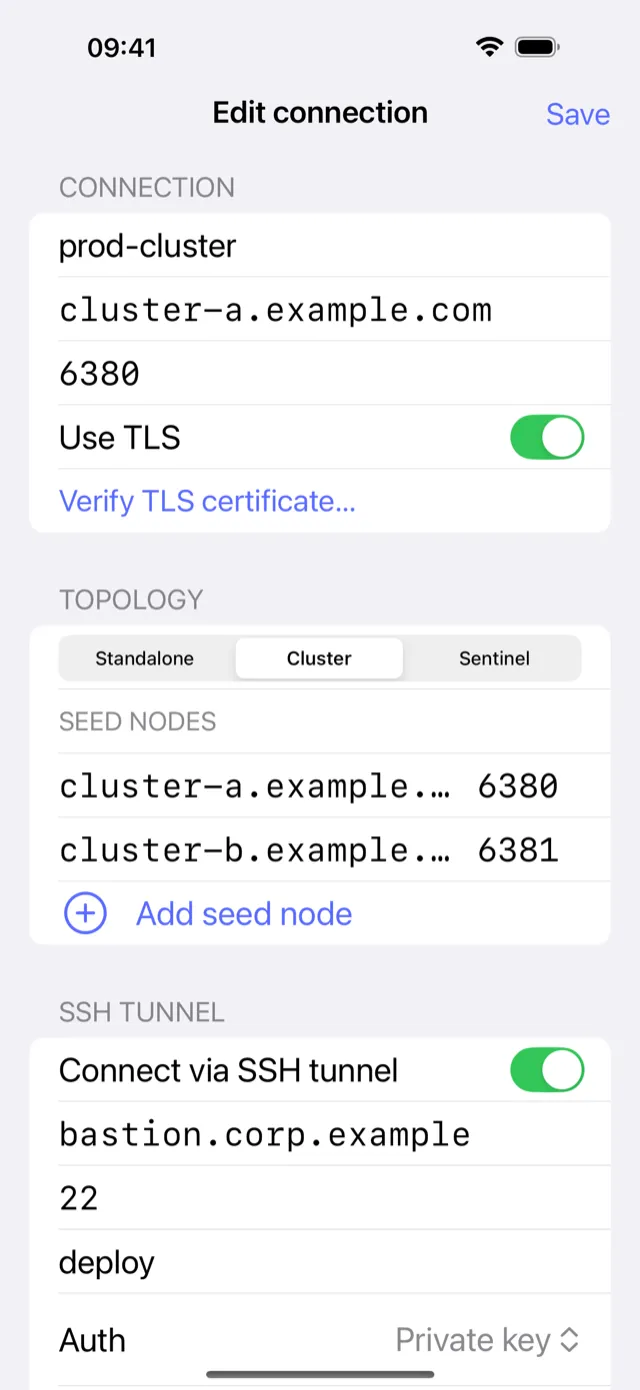
- Get your ElastiCache endpoint. In the AWS console, open ElastiCache → your cluster → Primary endpoint. It looks like
myredis.abc123.ng.0001.use1.cache.amazonaws.com. - Open CacheDeck and tap +. Enter the ElastiCache primary endpoint as the host. For TLS-enabled clusters, use port
6380. For non-TLS clusters, use6379. - Enable SSH Tunnel. Toggle Use SSH Tunnel. Enter your bastion EC2 public hostname or Elastic IP, port 22, and your EC2 username (
ec2-user,ubuntu, or your custom user). Import your EC2 key pair (Ed25519 or RSA). - Enable TLS if your cluster uses in-transit encryption. Toggle Use TLS. AWS ElastiCache TLS uses an Amazon-issued certificate; the iOS system trust store recognizes Amazon Root CA, so no custom CA upload is needed in most cases. If you see a certificate error, download the ElastiCache CA bundle from AWS and add it as a custom CA in CacheDeck.
- Add AUTH token if required. If your cluster uses an AUTH token (required when in-transit encryption is enabled without IAM auth), paste it in the Auth Password field.
- Connect. Tap Connect. CacheDeck opens the SSH session to the bastion, establishes the port forward to ElastiCache, and connects over the tunnel, all in one step.
ElastiCache features supported by CacheDeck
- Key browser: navigate and search all keys with pattern matching, TTL display, and value inspection
- In-place editing: edit strings, hashes, lists, sets, sorted sets, and streams directly; write protection on PROD-tagged connections
- CLI console: run any Redis command; full autocomplete and command history
- Pub/Sub monitor: subscribe to channels and watch messages in real time
- Server stats: memory usage, hit rate, connected clients, keyspace stats
- SSH + TLS combined: use both tunnel and TLS encryption on the same connection for double-layer security
Not yet supported: ElastiCache Cluster Mode (automatic shard discovery). CacheDeck connects to individual nodes. For Cluster Mode, connect to the primary endpoint of a specific shard directly.
Production safety for ElastiCache
ElastiCache in production carries the same risk as any Redis server: an accidental FLUSHDB on the wrong connection is destructive. CacheDeck's safety classifier tags connections as PROD when the connection name or hostname contains patterns like prod, production, or prd, which most ElastiCache cluster names include by convention. PROD-tagged connections require an extra confirmation tap before any write command executes.
Pricing
CacheDeck is free to download, with a one-time $4.99 Pro unlock: no subscription, no per-connection fee, all future updates included. iOS 17.0 or later required.
CacheDeck is on the App Store
Free to try, $4.99 Pro unlock. No subscription. iOS 17+.
Download on the App StoreLearn more: SSH tunnel to Redis from iPhone ·Azure Cache for Redis on iPhone ·Upstash on iPhone ·Full feature overview ·How to SSH into Redis from iPhone (step-by-step)
Redis is a trademark of Redis Ltd. Amazon ElastiCache and AWS are trademarks of Amazon Web Services, Inc. CacheDeck is not affiliated with Redis Ltd. or Amazon.